Social hierarchy and reversal of status
The Man Who LaughsSocial hierarchy and reversal of status organize the contrast between Gwynplaine’s life as a travelling performer and his recognition as Lord Fermain Clancharlie. His face makes him famous among ordinary spectators, but the laughter it provokes marks him as an outsider; his critique of royal privilege is treated as dangerous, while his aristocratic inheritance later gives him a place among the powerful. The reversal exposes how appearance, money, birth, and institutional recognition govern social standing, even as the suffering behind his spectacle remains unchanged.
Rank, wealth, and enforced silence
An early instance of Gwynplaine’s political awareness comes when he picks up a farthing while counting the troupe’s receipts. He contrasts the small coin with the royal image on a die: the farthing represents the people’s misery, while the royal effigy signifies the throne’s parasitic magnificence. Master Nicless repeats the observation, and it reaches Ursus by way of Fibi and Vinos. Its passage through this chain of listeners shows how a casual remark can travel beyond the speaker and acquire political danger.
Ursus responds by warning Gwynplaine that people of low rank must remain silent before those in power. His caution is not abstract: he says he has received blows from the great, and invokes punishments imposed for offenses ranging from cutting down a young tree to striking someone in a royal palace. He also recalls that Daniel Defoe was pilloried three years earlier for printing the names of members of Parliament who had spoken the previous evening. The examples make the unequal distribution of speech concrete: the powerful may act with impunity, while the poor risk punishment for words or minor acts. Gwynplaine’s criticism therefore unsettles the hierarchy not by changing it, but by naming its terms.
The performer as spectacle and outsider
Gwynplaine’s livelihood depends on a face that makes audiences laugh involuntarily. The narrative distinguishes that public reaction from his inner life: the expression is fixed, while his thoughts and feelings are not. Even grief, anger, pity, or astonishment can intensify the appearance of laughter. His face thus turns him into a public image that spectators read without regard for the person beneath it.
The response is double-edged. Gwynplaine’s act draws crowds and earns him renown at fairs and crossroads, but spectators often turn away after laughing, and women especially recoil from the sight of him. The account stresses that he is tall, well made, and agile, with the difference confined to his face. This contrast helps distinguish his social stigma from his capacity or character: the visible mark attracts attention, creates a means of earning a living, and simultaneously makes him difficult for others to contemplate. His status as a celebrated performer does not amount to acceptance on equal terms.
The empty box and the Duchess
The class divide becomes visible at a performance of Chaos Vanquished in Southwark. The yard and windows are crowded, but the compartment reserved for the nobility remains empty, leaving an conspicuous gap amid the packed audience. When the Duchess Josiana arrives, she occupies the box alone. Her jewels, fine dress, and commanding presence set her apart from the audience and the performers below; the scene presents her as belonging to a world of privilege that can look down upon the fairground.
The contrast is sharpened by a payment. After the performance, Ursus empties the troupe’s receipts onto the supper table, where a Spanish gold onza appears among the pennies. He recognizes it as the Duchess’s payment for her seat. The costly coin among the worn small change makes the difference in wealth tangible, just as the Duchess’s isolated place in the box makes rank visible in the theatre. She can cross into the performers’ space as a spectator without surrendering the social distance that separates her from them.
For Gwynplaine, the Duchess’s attention produces a startling reversal in the terms by which he understands himself. He has been accustomed to being laughed at and avoided; now a woman of immense rank desires him despite the face that has made him an object of public spectacle. The reversal temporarily makes his stigmatized appearance seem like a source of distinction. Yet it does not dissolve the difference between them: her freedom to choose and approach him is itself enabled by the elevated position she occupies. The scene reverses the expected direction of desire while keeping the unequal social structure in view.
Recognition and the limits of reversal
When Gwynplaine is brought before the sheriff, he identifies himself as a travelling mountebank who has earned an honest living for fifteen years and asks to be released. The sheriff instead addresses him as Lord Fermain Clancharlie, Baron Clancharlie and Hunkerville, and Marquis of Corleone in Sicily, then offers him a seat. In a moment, the same man who presented himself as poor and without protection is treated as a peer. The change is not produced by a change in his face or by a new account of his actions, but by the announcement of his inherited title.
That recognition reverses his official standing, but it does not undo the experiences that preceded it. The fairground audience knew him as a comic attraction; the sheriff’s form of address reveals that institutions classify him differently once his lineage is established. The episode makes rank appear both powerful and conditional on recognition: his birthright has existed while he lived as a performer, yet it only alters how authority treats him once it is disclosed.
From personal stigma to political symbol
Gwynplaine’s speech in the House of Lords makes the contrast between individual status and collective suffering explicit. When a peer calls attention to the apparent incongruity of his presence, Gwynplaine refuses the designation of exception. He presents himself as representative of the people and argues that the rulers’ treatment of him reflects the mutilation of humanity under their rule. His imposed smile becomes, in his argument, an emblem of suffering hidden beneath an appearance that invites laughter.
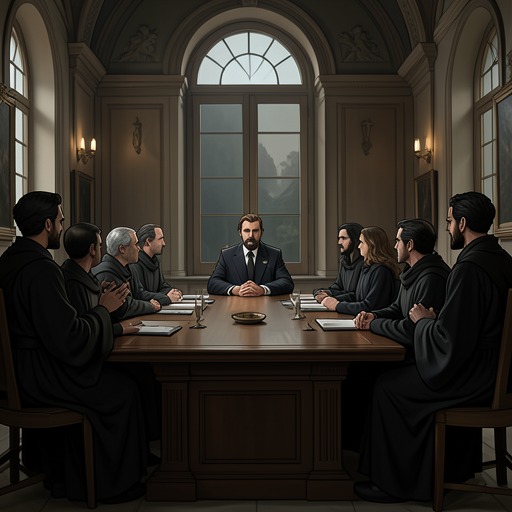
The speech also turns the earlier farthing and royal die into a larger political opposition. The poor may be laughed at or kept silent, while the aristocratic order occupies the chambers of authority; Gwynplaine’s presence brings the excluded performer into that chamber as both titled peer and accuser. He invokes the Republic and Cromwell’s overthrow of the kings as precedents for the possibility that entrenched power can fall. The novel’s reversal is therefore at once personal and emblematic: Gwynplaine crosses the boundary into aristocratic status, then uses that position to challenge the hierarchy. His story makes the contradiction unmistakable—the system recognizes him as a lord because of his birth, while his argument insists that the people whose suffering he represents should not remain social exceptions.